If These Medicines Are Instruments of Prayer
A reflection inspired by Bané's teaching on Nishipa, Hapé, and what it means to walk in true reciprocity with the communities who have carried these prayers for generations.
Teresa Padilla
7/1/20262 min read
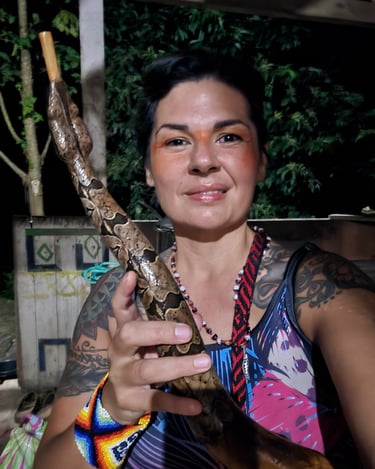
Reflections on Reciprocity
One of the teachings Bané shared with me has stayed deeply in my heart.
During one of our conversations, I asked him a question that had been on my heart for some time:
"How do you know when someone is ready to serve Hapé?"
His response surprised me. Rather than speaking about skill, experience, or authority, he spoke about the path itself.
As a spiritual leader of the Huni Kuin people, Bané carries teachings rooted in the wisdom of his ancestors, teachings that have been protected, lived, and passed forward through generations. One of those teachings is that "when we are on the path of the school of spirituality, we need to learn the mechanism of using the instruments like, Nixi and Hapé. They are instruments of prayer." Those simple words carry tremendous depth. If these medicines are instruments of prayer, then our relationship with them should also be prayer. There is something I have been reflecting on that feels important to speak about.
In many Western organizations and institutes, Indigenous voices are being used to promote programs, retreats, and platforms built around Indigenous medicines. While many of these efforts come from sincere intentions, there is also a growing pattern where Indigenous knowledge is being shared without cultivating true, long-term relationship with the communities who have carried these prayers for generations.
Some organizations have worked hard to build long-term relationships rooted in trust, partnership, and mutual support. Others have built platforms, businesses, and reputations around Indigenous medicines and Indigenous voices without creating the same level of reciprocal relationship with the communities from whom those teachings came.
For me, this raises an important question. If we receive these prayers, these medicines, and these teachings, how do we also help carry the communities that have protected them for generations?
To me, reciprocity is more than financial support. It is relationship. It is showing up over time. It is listening. It is learning. It is asking how we can walk together rather than deciding for others what support should look like. It is the difference between inviting Indigenous people onto our platform and building the platform together. It is the difference between speaking for Indigenous voices and helping Indigenous voices speak directly.
This is how I have come to understand Bané's teaching.
If Nishipa and Hapé are instruments of prayer, then our relationship with them should also be prayer. That means our relationship with the people who have carried those prayers for generations should be marked by humility, gratitude, trust, and reciprocity, not just learning from them, but walking alongside them over time.
That, to me, is what true partnership looks like.
Join us in healing and honoring traditions
Connect
Follow
mmtinc25@gmail.com
720-364-1798
© 2026. All rights reserved.
Photography: Selected images throughout this website are shared with permission by members of our community and contributing photographers. We are deeply grateful for their generosity in helping tell the story of Medicine of Many Tribes, our Indigenous partners, and the communities we serve.
Medicine of Many Tribes is a Colorado nonprofit religious corporation and is in the process of applying for federal 501(c)(3) tax-exempt status.